Walk into any health food store or scroll through any online shop, and you will find dozens of matchas claiming to be premium, ceremonial grade, or Japanese authentic matcha. Most of them are not lying exactly — but they are not telling you the full story either.
Here is what actually matters on a matcha label, and what is just noise.
1. Origin: Japan — and ideally, where in Japan
The first thing to check: is it made in Japan?
Matcha is not simply powdered green tea. It is the product of centuries of accumulated knowledge — shaded cultivation, precise harvesting, specific milling techniques — developed alongside Japanese culture, tea ceremony, and a deep understanding of the land. That knowledge took hundreds of years to build. It cannot be replicated in a few seasons of cultivation elsewhere.
Powdered green tea produced outside Japan may look similar. But calling it matcha — and selling it as premium or ceremonial grade— is misleading. The technical foundation, the terroir, and the cultural context are simply not there yet. Until that changes, Japane-grown is non-negotiable.
Beyond Japan, the region matters. Japan’s established matcha-producing regions each have distinct characteristics shaped by their soil, climate, and tradition: Uji and Wazuka in Kyoto, Shizuoka, Aichi, Fukuoka, and Kagoshima. Labels that specify a region show that the producer has nothing to hide about origin. If the label simply says “Japan” without further detail — there is a doubt.
The more specific the origin, the more confident you can be.
2. Harvest: First harvest (ichibancha) is the gold standard
Japanese tea is harvested multiple times per year. The first harvest — ichibancha 一番茶, typically in May — produces the youngest, most tender leaves, with the highest concentration of L-theanine, chlorophyll, and umami. The flavour is smooth, sweet, and complex.
In Japan, the arrival of ichibancha is a cultural moment. Tea shops across the country fill with shin-cha 新茶 — new harvest gyokuro and sencha — marking the beginning of spring. It is the most anticipated tea of the year, and for good reason: the leaves that have rested through winter, slowly accumulating nutrients, are at their most vibrant.
For matcha specifically, there is an important nuance: unlike sencha, high-grade matcha undergoes an ageing period after the harvest before it is milled. So there is no such thing as new-season matcha in the same immediate sense in Kyoto — but the quality of the ichibancha leaves used is everything.
Second harvest (nibancha) and third harvest (sanbancha) leaves are coarser, less aromatic, and more bitter. Lower-grade matchas are often made from later harvests, or from blends of multiple harvests across different seasons — sometimes from different farms and regions entirely.
The finest producers harvest only once per year. When ichibancha is done, the tea plants are left to rest, growing naturally until the following spring. That restraint is a choice — and it comes at a cost. First harvest matcha is more expensive because there is simply less of it, and because the farm has committed an entire year to a single harvest.
All matcha sold by MUSUBI MATCHA is made exclusively from ichibancha — the top of the first harvest, picked once a year. If a label does not mention the harvest at all, it is worth asking why.
3. Processing: Stone-milled, and slow
This is one of the most important — and most overlooked — details on a matcha label.
Before it becomes powder, matcha starts as tencha 碾茶: dried tea leaves, stripped of their stems and veins, carefully prepared for milling. What happens next makes all the difference.
Stone-milling is slow by design. A single granite mill wheel, rotating at low speed, grinds the tencha into an ultra-fine powder — approximately 30 to 40 grams per hour. The low speed prevents heat build-up. And heat is the enemy of matcha. High temperatures degrade catechins, EGCG, and the volatile aromatic compounds that give premium matcha its depth, sweetness, and vivid colour. Stone-milled matcha also retains a higher concentration of antioxidants — meaning the difference is not only sensory, but nutritional.
Industrial ball mills work faster and at higher temperatures. The result is a powder that may look similar, but lacks the fineness, the fragrance, and the nutritional integrity of its stone-milled counterpart.
When you are buying matcha in a shop, information can be limited. But most matcha is now sold online — and there, you have access to full product descriptions. Use them. Look specifically for the milling method. Is it stated clearly? If a brand does not mention how their matcha is milled, the answer is almost certainly: by machine. Genuine stone-milled matcha is something producers are proud of — they say so.
As a rule: if the price seems surprisingly low, the milling method is not mentioned, or the description focuses only on flavour and colour without explaining the process — it is most likely industrially milled.
Stone-milling is not a detail. It is the process that determines whether what is in your bowl is truly matcha.
4. Cultivar: Single or known blend
The cultivar — the specific variety of tea plant — is one of the clearest indicators of quality and transparency on a matcha label.
The best matcha is made from a single, named cultivar. When a label states the cultivar clearly — Okumidori, Samidori, Asahi, Sayamakaoru, or others — it means the producer knows exactly what is in the tin, and is confident enough to tell you. Single-cultivar matcha has a defined flavour profile: traceable, consistent, and specific to that variety and that origin.
Some high-quality matchas use a ceremonial blend — a combination of top-grade cultivars, carefully assembled to achieve a consistent and refined flavour profile. This is a legitimate and traditional practice in the world of tea ceremony. The key word is intentional: the best ceremonial blends are made from exceptional single-cultivar matchas, blended by a skilled tea master.
What to be cautious about: labels that list no cultivar at all, and describe the product only as “Japanese matcha or made in Japan” or “premium matcha or ceremonial matcha” without further detail.
In the current market — where Japan has no official certification system for matcha — this lack of information is significant. It often indicates a blend of second or third harvest leaves, from different farms, different regions, or different seasons. In the worst cases, it may contain powdered green tea that was never produced as tencha — the specific dried leaf that forms the basis of genuine matcha. This is more common than most consumers realise, and it is one of the reasons why cultivar transparency matters so much.
Japan is currently working toward an official matcha certification system. Until that exists, the cultivar name on a label is one of the few reliable signals of authenticity.
Representative cultivars by region:
Uji/Wazuka, Kyoto Okumidori — One of the most balanced and refined cultivars available. Smooth umami, vivid colour, fine texture. Widely regarded as ideal for high-grade usucha. It is worth noting that the same cultivar grown by different producers, or in different microclimates within Kyoto, can taste remarkably different — terroir matters here as much as in wine.
Samidori — Deep green, rich umami, full-bodied.
A classic of Uji. Asahi — One of the oldest traditional cultivars of Uji. Delicate, slightly sweet, historically prized for ceremony.
Shizuoka Yabukita — Japan’s most widely planted cultivar. Reliable and pleasant, though less complex than Kyoto varieties at the highest grades.
Aichi / Nishio Saemidori — Bright colour, light sweetness, approachable profile.
Fukuoka / Kagoshima Okuyutaka, Yutakamidori — Productive cultivars suited to warmer southern climates, more commonly used in culinary-grade matcha.
A final point worth repeating: the same cultivar — even Okumidori — will taste entirely different depending on the producer, the soil, the altitude, and how the farm manages its fields. A cultivar name tells you what variety of plant was used. The farm behind it tells you everything else.
5. Organic certification: JAS, not just a logo
The tea plant accumulates pesticide residues in its leaves. With matcha, you consume the entire leaf — ground to powder. This makes the choice of organic matcha particularly important for anyone drinking it regularly.
The certification to look for is JAS — Japanese Agricultural Standard. This is Japan’s official organic label, equivalent to the European AB certification. It requires full conversion of the land (minimum three years), zero synthetic pesticides, and zero chemical fertilisers. It is independently verified.
Important: in Japan, certified organic tea farms are rare. In Kyoto, there are only a handful. A JAS-certified matcha from Wazuka or Uji is genuinely uncommon — and genuinely valuable.
6. What to ignore: “Ceremonial grade”
This term appears on almost every premium matcha sold in the West. It is not regulated, not certified, and not defined by any official body. Any producer can use it. It tells you nothing about the harvest, the cultivar, the milling method, or the origin.
My own definition: a matcha worthy of being prepared as usucha — just powder and water — is one that tastes delicious without any addition. That is the only test that matters.
The checklist: what the best matcha labels say
The finest matchas — those worth drinking as usucha — will typically state:
-
Origin: Japan, ideally with a specific region (Uji, Wazuka)
-
Harvest: First harvest / ichibancha
-
Processing: Stone-milled
-
Cultivar: Single variety or named ceremonial blend
-
Certification: JAS organic
If a label checks all five, you are looking at a genuinely high-quality product. If it checks none and simply says “ceremonial grade premium matcha,” keep looking.
What full transparency looks like in practice
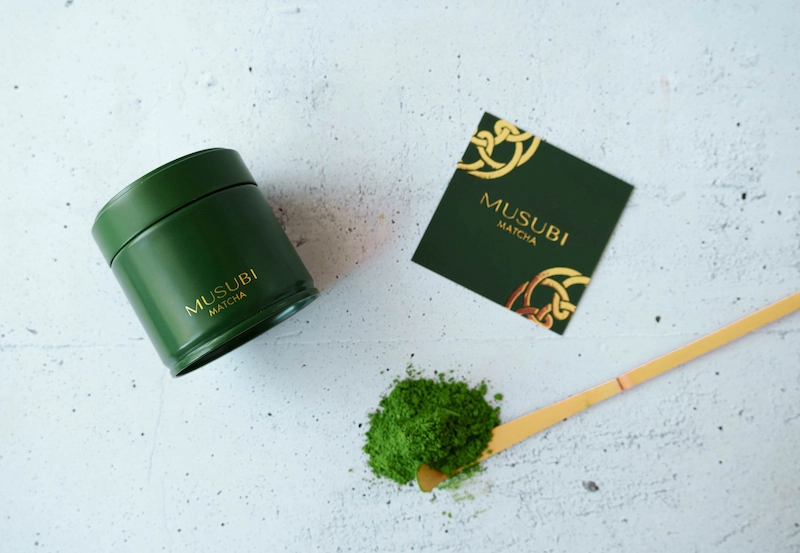
At MUSUBI MATCHA, we built the brand around one principle: you should be able to verify everything on the label.
Our matcha comes exclusively from Nakai Organic Tea Garden in Wazuka, Kyoto — a family farm that has been cultivating tea for over 350 years, and one of the first tea farms in Japan to obtain JAS organic certification, over 40 years ago. We source directly, with no intermediaries. We can tell you the farm, the field, the cultivar, the harvest date, and the exact quantity produced that year.
Our Premium Reserve is the highest expression of this commitment. Single cultivar. First harvest. Stone-milled in small batches. Aged for 8 months before grinding to develop greater depth and roundness. Limited to 100 units. Once it is gone, it does not return until the following harvest in 2027.
It checks every box on the list above. And then some.
→ Pre-order Premium Reserve — 100 units only
Written by Ryoko Benoist – founder of MUSUBI MATCHA, a certified Japanese Tea Advisor, and the author of Matcha — Histoire, tradition et recettes (Éditions La Plage, 2025). MUSUBI MATCHA sources exclusively from a family farm in Wazuka, Kyoto, of over 350 years, and one of the first in Japan to obtain JAS organic certification.
Discover our matcha → shop now