
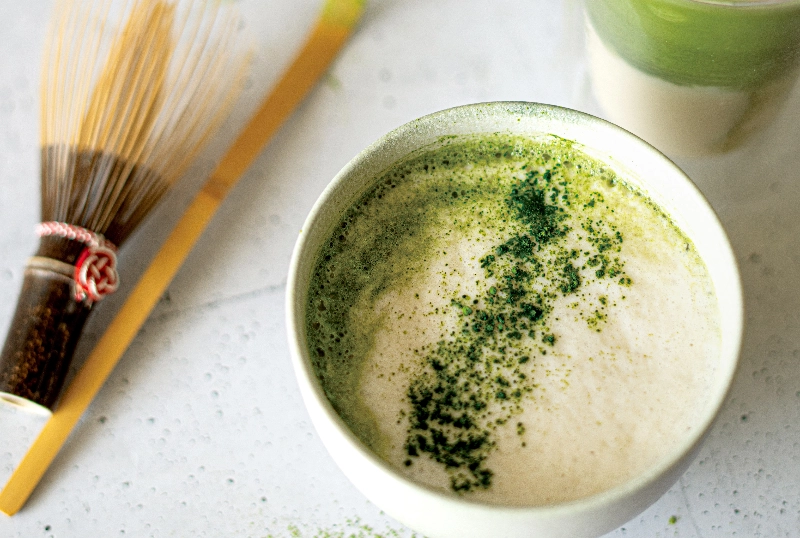
You do not need the highest-grade matcha for a latte. The delicate umami and sweetness of fine matcha are muted by milk. A good Japanese matcha of a slightly lower grade, with a more assertive character, holds up better against milk and makes a latte that actually tastes of matcha. Keep your finest matcha for drinking pure, with hot water alone.
I have been writing about the different grades of matcha and their different uses. Today, I want to explain why you do not necessarily need the highest-quality matcha for your latte.
Scroll through any European café menu or matcha lover’s Instagram feed, and you will see it everywhere: premium or so-called ceremonial grade matcha, proudly whisked into steamed oat milk and served as a latte.
It looks beautiful. It costs a fortune. And it is not necessarily the best choice for what is in the cup.
In Japan, this would raise an eyebrow or two. Anyone who has spent time around traditional tea culture knows that different grades of matcha exist for different purposes. Using the finest matcha in a latte is a little like opening a grand cru Burgundy to make a wine sauce.
Technically possible. But you are pouring your money, and your flavour, straight down the drain.
Why Ceremonial Grade Matcha Gets Lost in a Latte
Here is the science behind the intuition. High-grade matcha is prized for its deep umami, its gentle sweetness and its almost creamy texture when whisked with hot water. The finer the matcha, the more delicate its flavour. And delicate flavours do not survive milk.
Those qualities come from shade-grown leaves, harvested early in spring and slowly stone-ground into a fine powder. But when you add milk, especially a rich whole milk or a barista oat milk, those subtle notes are coated, muted and ultimately lost.
You end up with a pleasant green drink, but the matcha is barely a whisper.
The Best Matcha for Lattes: A More Assertive Grade
A lower grade has a slightly more assertive character: a touch more bitterness, a little more astringency. In a bowl of tea, you might find these qualities less refined.
But in a latte, they are exactly what you need.
Those stronger notes hold their ground against the milk. A little honey or sugar draws out the vegetal depth. The result is a latte that actually tastes of matcha: vivid, satisfying and well balanced.
This is not a compromise. It is the right tool for the right job.
Build Your Matcha Shelf: One Matcha for Lattes, One for the Bowl
Once you understand this, the way you build your matcha shelf changes entirely.
|
|
For lattes |
For drinking pure |
|---|---|---|
|
Grade |
A good Japanese matcha with a more assertive character |
Your finest matcha |
|
Flavour |
Bolder, slightly more bitter and astringent |
Deep umami, natural sweetness, smooth |
|
Preparation |
With milk, plus honey or sugar if you like |
Whisked with hot water as usucha or koicha, nothing else |
|
When |
Everyday lattes |
Moments when it can truly shine |
Keep a lower-grade matcha for your daily lattes, and save your finest matcha for the moments when nothing stands in its way. If your pure matcha tastes bitter, read my guide on why matcha tastes bitter and how to fix it.
MUSUBI MATCHA: Crafted for Usucha and Koicha
All MUSUBI MATCHA is crafted for traditional usucha, and Premium Reserve is for koicha preparation, faithful to the authentic Japanese tea tradition. I currently offer two distinct organic matchas from Wazuka, Kyoto, one of Japan’s most respected tea-growing regions.
Once you have seen the craftsmanship, the ageing, the rarity and the complexity behind a true highest-grade matcha, it becomes difficult to imagine using it simply for a latte.
MUSUBI MATCHA Premium Reserve: now available for pre-order
For those who wish to experience one of the highest expressions of authentic Japanese organic matcha, MUSUBI MATCHA Premium Reserve is now available for pre-order.
Produced in an extremely limited quantity of only 100 units, this exceptional matcha is crafted for both usucha and koicha, with remarkable depth, a vivid aroma, powerful umami and extraordinary smoothness.
Once sold out, the next production will not be available before January 2028.
Frequently Asked Questions
Can you use ceremonial grade matcha for lattes?
You can, but most of what makes it special is lost. Milk mutes the delicate umami and sweetness of fine matcha. A good matcha with a bolder character gives a better latte, and keeps your finest matcha for drinking pure.
What grade of matcha is best for lattes?
A good Japanese matcha of a slightly lower grade, with a more assertive, slightly bitter character. Its stronger flavour holds up against milk and sweeteners, so the latte still tastes clearly of matcha.
How do I choose a matcha for lattes?
Even for lattes, choose a Japanese matcha with its region of origin stated, a bright green colour and a fresh aroma. A dull, yellowish powder will taste flat in a latte too.
Is ceremonial grade matcha a waste of money in a latte?
In most cases, yes. You pay for subtlety that milk hides. It is a little like cooking with a grand cru wine: possible, but the finest qualities never reach the plate.
What is the best way to enjoy high-grade matcha?
Whisked with hot water alone, as usucha (thin tea) or koicha (thick tea). With nothing in the way, its umami, sweetness and aroma can fully express themselves.
Written by Ryoko Benoist, founder of MUSUBI MATCHA, certified Japanese Tea Advisor and author of Matcha: Histoire, tradition et recettes (Éditions La Plage, 2025). MUSUBI MATCHA sources exclusively from a family farm in Wazuka, Kyoto, with more than 350 years of tea-growing history.
Discover our matcha → Shop now