As you may know, not all matcha is the same. As global demand for matcha grows, the market is increasingly filled with products labeled “matcha” that are very different from authentic Japanese matcha. So how can you tell real matcha from fake matcha? The answer lies in color, origin, grade, and production method. Let’s start with the most visible difference
1. Color: The First and Clearest Indicator
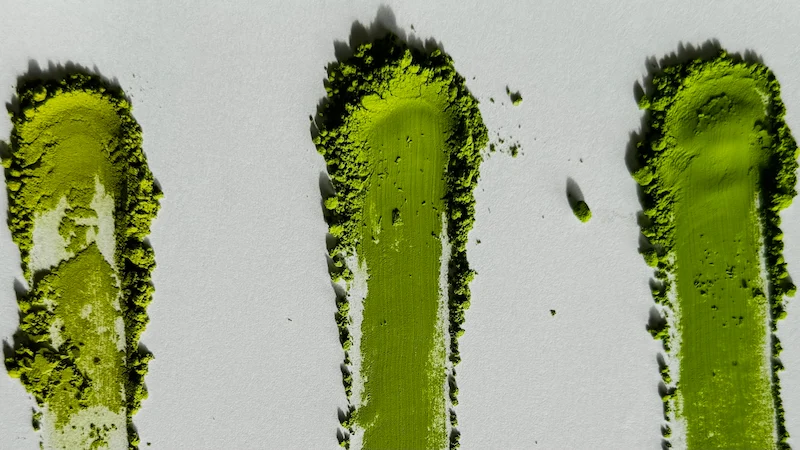
Real (high-quality) matcha has a vivid, vibrant green color. High-quality Japanese matcha is made from carefully shaded tea leaves (tencha), stone-milled into an extremely fine powder.
There are two main shading methods used in Japan.
One is tana-style shading, where tea plants are covered with traditional shelf-like structures that create natural, diffused shade.
The other is direct covering, where materials are placed directly over the plants.
Tana shading requires significantly more time, labor, and space, but it places far less stress on the tea leaves. Because the leaves grow slowly under gentle shade, they develop higher amino acid content and a smoother, more refined flavor.
For this reason, matcha produced from tana-shaded tencha is considered higher grade and far more rare.
After harvest, the way matcha is milled also makes a critical difference.
Traditional stone milling is extremely slow and precise, producing only about 40 grams per hour per mill.
This slow process prevents heat and friction, preserving aroma, color, and delicate flavor.
In contrast, high-speed mechanical milling can produce large volumes quickly, but often generates heat that degrades quality.
Matcha made with stone mills is therefore not only higher in quality, but inherently limited in quantity — making it one of the most scarce forms of Japanese green tea.
Because stone milling is extremely slow, the tea leaves are ground gently, without generating excessive heat. This is important not only for flavor and aroma, but also for nutritional quality.
When matcha is milled slowly and carefully, it retains a higher amount of catechins — natural antioxidants found in tea.
Catechins are sensitive to heat, and high-speed mechanical grinding can degrade them through friction and temperature rise.
This means that traditionally stone-milled matcha, produced slowly and in small quantities, tends to preserve more of these beneficial compounds.
In other words, the same process that creates smoother taste and vibrant color also helps maintain matcha’s natural health-supporting properties.
What Is Often Called “Fake Matcha”
As demand increases, many products labeled as matcha are made using shortcuts that compromise both quality and integrity.
So-called fake or low-quality matcha often shows clear signs:
dull, yellowish, or brown-green color
bitterness without sweetness or umami
coarse texture rather than a fine, silky powder
These products may be made from:
second or third harvest tea leaves
leaves not grown specifically for matcha
stems, veins, or mixed plant parts rather than leaf flesh alone
In many cases, the powder is produced using high-speed mechanical milling, where leaves are ground quickly into powder rather than slowly stone-milled.
This process generates heat, reduces aroma, degrades color, and results in a harsh, flat taste.
Such matcha is often labeled as “culinary grade” or described as suitable for cooking or bitterness lovers.
While lower-grade matcha has its place in food applications, it is fundamentally different from high-quality matcha intended to be enjoyed simply with water.
2. Origin Matters: Japan vs Mass Production
Authentic matcha comes from Japan, where matcha production follows centuries-old methods rooted in tea ceremony culture.
Traditionally, the heart of this culture has been Kyoto, where matcha was developed and refined over more than 800 years in connection with Zen practice and the Japanese tea ceremony.
Kyoto’s climate, soil, and accumulated knowledge shaped the techniques of shading, harvesting, and grinding that define what matcha truly is today.
For this reason, Kyoto has long been regarded as the historical birthplace and cultural center of authentic Japanese matcha.
In contrast, China has rapidly expanded large-scale matcha production to meet global demand.
While Chinese-produced matcha may be inexpensive and visually appealing, there are important differences:
leaves are often not grown specifically for matcha
shading periods are shorter or absent
milling is usually industrial, not stone-based
flavor is flatter, more bitter, and less complex
Matcha is not just powdered green tea.
Without the right cultivation and processing, it loses its depth, sweetness, and cultural integrity.
3. Understanding Matcha Grades (And Common Misconceptions)
The terms “ceremonial grade” and “culinary grade” are often misunderstood.
Traditionally, matcha grades were not designed for marketing, but for how the matcha is used.
High-quality matcha is intended for:
Usucha 薄茶 (thin tea)
Koicha 濃茶 (thick tea)
These preparations require matcha that is:
naturally sweet
low in bitterness
smooth and complex
Lower-grade matcha, often labeled “culinary,” is typically made from later harvests or different leaves and is used in:
baking
desserts
lattes
Calling something “ceremonial grade” does not automatically make it high quality.
The true test is whether it can be enjoyed pure, with water only.
4. Why the Rise of Fake Matcha Is a Problem
As demand increases, mass-produced matcha has flooded the market.
The problem is not competition — it’s confusion.
When low-quality powders are sold as matcha (even ceremonial matcha!!) :
consumers lose trust
authentic producers are undervalued
the cultural meaning of matcha is diluted
Real matcha is the result of time, skill, and generational knowledge.
It cannot be rushed or industrialized without losing its essence.
5. What Real Matcha Tastes Like
Authentic matcha is:
smooth
umami-rich
gently sweet
never aggressively bitter
Fake or low-quality matcha often tastes:
harsh
chalky
overly bitter
flat
Taste confirms what color and origin already reveal.
Choosing Matcha with Awareness
Knowing how to tell real matcha from fake matcha allows you to choose with intention.
Real matcha reflects:
its origin
its producers
and a philosophy rooted in care and precision
It is not simply a green powder, but a cultural craft.
To receive future articles from the Matcha Journal, you can subscribe here → Newsletter Subscription
Written by Ryoko Benoist – founder of MUSUBI MATCHA, a certified Japanese Tea Advisor, and the author of Matcha — Histoire, tradition et recettes (Éditions La Plage, 2025). MUSUBI MATCHA sources exclusively from a family farm in Wazuka, Kyoto, of over 350 years, and one of the first in Japan to obtain JAS organic certification.
Discover our matcha → Shop now