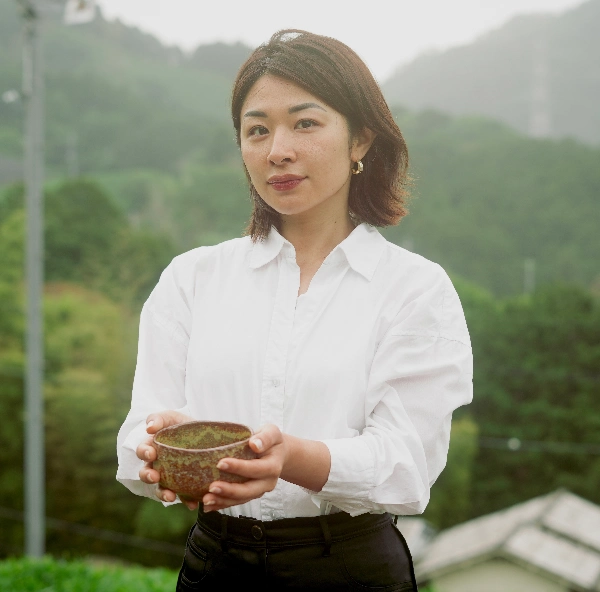
I’m Ryoko, the founder of MUSUBI MATCHA. today I want to share with you the different between Koicha 濃茶 and Usucha 薄茶. During my Matcha Masterclass , my participants often ask me “What’s the difference between usucha 薄茶 and koicha 濃茶?”, they often expect a simple answer like “one is lighter, one is stronger.” That’s true, but it misses the point. In chanoyu 茶の湯 (the Japanese Way of Tea), usucha and koicha are not just two recipes. They represent two different moments, two different kinds of attention, and historically, two different ways of gathering.

Koicha and usucha in the tea gathering: which comes first?
In a formal tea gathering (chaji 茶事), koicha is the central moment, and it is traditionally followed by usucha. Koicha is not a “stronger usucha”; it is the heart of the gathering, then usucha comes as a more relaxed, closing atmosphere.
This difference also appears in the choice of matcha bowls. For koicha, the setting is more formal, and the chawan is often more restrained and dignified. Plain, unglazed bowls such as Raku chawan are frequently chosen to match the gravity of the moment.
For usucha, the mood opens up. Seasonal bowls with lighter decoration or subtle patterns are often selected, and the tea is enjoyed in a calmer, more relaxed atmosphere.
Historically, Japanese documents begin distinguishing “usucha” and “koicha” in the Tenmon era (1532–1555), and the term “koicha” is documented by 1575.
The shared bowl: why koicha is about connection
One of the most striking differences is how koicha has been served. Traditionally, the host prepares one bowl of koicha and it is shared among guests. This “shared bowl” style appears in historical documents in 1586 and is associated with Sen no Rikyū. Usucha, by contrast, is served in individual bowls.
That single bowl matters. Koicha is often described as the moment where the guests become “one gathering,” literally sharing the same tea. The ritual includes wiping the rim before passing it on, which is part of the etiquette and care.
How the pandemic reshaped koicha in practice
Koicha’s shared bowl is powerful, but it is also physically intimate. During the COVID era, many tea events adapted their format and precautions (for example, moving outdoors, limiting participants, or modifying procedures).
What I find especially telling is that even within formal contexts, koicha can be prepared in individual bowls in certain styles. For example, Urasenke’s official event report (2021) describes koicha being prepared in individual bowls (kakufuku-date temae). That kind of choice reflects how living traditions respond to real-world constraints while trying to preserve meaning.
The practical difference: texture and technique
Usucha (薄茶) is “thin tea.” It’s whisked to create foam, with a light, vibrant body.
When I say usucha is “whisked to create foam,” I should add one important point: the look of that foam depends on the tea school. In Urasenke, the standard is a fine, even layer of foam across the surface. In Omotesenke and Mushakōjisenke, the tea is typically whisked with less foam, leaving a clearer “pond” area (often described as a crescent or window) so the liquid surface is more visible.
In this journal, I’m focusing on Urasenke-style usucha, because it’s the approach I most often teach and prepare when I introduce people to matcha.
Koicha (濃茶) is “thick tea.” It is not whipped into foam. It is kneaded slowly until glossy and smooth, almost like a dense emulsion.
This is why koicha reveals everything about the matcha. With no foam and no dilution, there is nowhere to hide.
Why koicha requires the highest-grade matcha
Koicha traditionally calls for the best matcha available because any harshness or coarse bitterness becomes amplified at that concentration. Many guides explicitly state that koicha is reserved for the highest quality matcha to achieve a smooth, luxurious flavor.
If you try to make koicha with a matcha that is fine for lattes or everyday mixing, the result can turn astringent, rough, and unpleasantly heavy. When koicha is made with truly high-grade matcha, it becomes something else entirely: deep umami, mellow sweetness, long finis
Taste and decide: which one should you drink?
If you want an everyday ritual that is bright, approachable, and easy to repeat, usucha is the natural choice.
If you want the most concentrated expression of matcha, and you have truly high-grade matcha (and the patience to knead it properly), koicha is incomparable.
Unfortunately, our Premium Reserve matcha for koicha is currently sold out. This matcha is extremely limited, and the annual harvest is only about 50 kg… this year the global demand was simply too high for us to secure any allocation. I’m hopeful we’ll be able to bring it back next year.
If you’d like the full, step-by-step guide to making usucha (thin tea) I shared it in my previous journal. You can read it here: How to prepare Usucha – Step-by-step traditional way to enjoy matcha
Written by Ryoko Benoist – founder of MUSUBI MATCHA, a certified Japanese Tea Advisor, and the author of Matcha — Histoire, tradition et recettes (Éditions La Plage, 2025). MUSUBI MATCHA sources exclusively from a family farm in Wazuka, Kyoto, of over 350 years, and one of the first in Japan to obtain JAS organic certification.
Discover our matcha → Shop now